


Sometimes I just can’t help but utilize what someone else has posted with their well researched effort to augment my Stack. The reason being, Liz put a lot of her time, energy and effort into this post and yet has had but a little exposure. Since her subscriber list is a lot less than mine, I felt it fitting to mirror her effort as it is well done and proves a point. Brutus WAS right about everything he wrote about. Sad to say, history has proven him right. So after you read this, please go subscribe to Liz LaSorte’s effort at being a ROARING lioness in the jungle we call the world. C.L.
Brutus Was Right About Everything
And yet he remains one of America’s most obscure and unknown founding father.
by Liz LaSorte
Nov 20, 2025

Robert Yates (aka Brutus of the “Anti-Federalist” Papers) was a wise founding father who understood why creating a strong central government would end badly. When reading his prescient arguments today, he predicted our present reality – an overblown, overgrown, corrupt federal government, usurping individual and state rights by an “uni-party” political class - a taxpayer-funded oligarchy - getting rich off the taxpayers. (Actually getting rich off the fake money created out of thin air due to the Federal Reserve act of 1913. See Thank You Federal Reserve What Would We Have Done Without You? C.L.)
And We the People allow this to continue, insisting that voting that bad guy out will fix the problem. Unfortunately, those attracted to powerful positions are often sociopathic types, so another self-serving sociopath replaces the outgoing self-serving sociopath, often with no real-life experience in the private sector (!) and here we are.
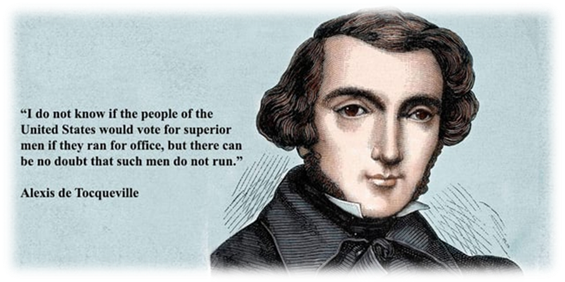
Since Brutus was on the losing side of the argument, he became memory-holed, and will remain there unless We the People resurrect his arguments, and debate the many reasons why any strong, central government will grow beyond our control, as he described in Brutus I - XVI.
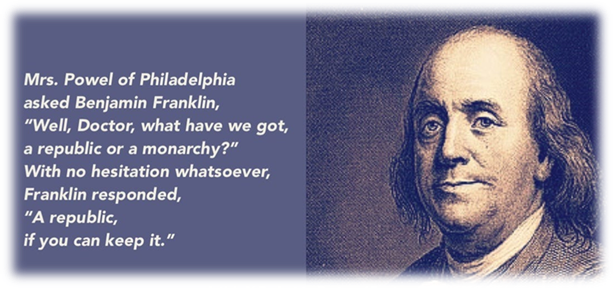
There comes a time when we must face reality and that reality is that we did not keep our constitutional republic, designed with the enumerated powers that would be “few and limited.”
We can argue/debate when and how it happened. If the left even acknowledged that we were organized as a constitutional republic (and not a democracy) and understood all the reasons why democracies never last, they would still insist that ‘democracy’ ended during the “King Trump” era, while ignoring the real kings in the House, Senate, supreme court, and the deep state.
Some will say it started with Lincoln’s nationalism during the civil war, but the horrors of slavery should taint that idea. Some might designate 1913, a date that should live in infamy, as the year that ended our constitutional republic, and they would have a strong case. Certainly, socialism crept into our government during the 1930s and never turned back, pushing too many Americans further into dependency on the government.
And some might argue that it was in 1787-91, with the Necessary and Proper Clause combined with the Supremacy Clause, that would not only expand the powers favoring a new aristocratic class, but could (and would) supersede individual and state rights.
But what difference, at this point, does it matter when the constitutional republic ceased its existence? What we are left with is the fact that our government is vastly corrupt and we are no longer free when We the People go broke as we continue to feed an insatiable and uncontrollable beast of a monster with an increasing $38 trillion-dollar national debt. (I have to interject a point here…that is what is the debt in or of? I’ll send 100 pounds to anyone who can identify it. It is all make believe. Seem my Blood Running in the Streets for a economics lesson you won’t get with a four year degree in economics. That post needs a dramatic update when it comes to the value of gold and silver! C.L.)
Even an employee in the 1950s did not have an optional box to choose “No” to have social security taken out of his paycheck, let alone choose to be taxed on income or how those tax dollars would be spent. How can we say we live in a free country when we have no choice but to pay our increasingly higher taxes or risk ruin if we don’t pay up?

Meanwhile, back in 1787-88, Brutus warned us of the numerous reasons why we do not want a strong, central government.
Brutus understood why term limits were critical when he said:
“The senators are chosen for six years, and they may be continued by re-elections for life. This, in my opinion, is a great defect in the constitution... It is a wise policy in republics to erect a body of men, who shall be the guardians of the laws, and who shall watch over the liberties of the people; but it is a dangerous policy to entrust them with too much power, or to suffer them to continue too long in office. The senate of Rome, which was the model of our senate, was at first chosen for five years, and afterwards for life; but it became so corrupt and tyrannical, that the people were obliged to reform it... Rotation in office is one of the best securities for the preservation of liberty.” Brutus XVI
“The house of representatives is to be elected for two years, which is a short time; but the senate is to be chosen for six years, which is a long time. The house of representatives is to be elected by the people, but the senate is to be chosen by the state legislatures... This will create a dependence in the house upon the senate, and the senate will control the house.” Brutus XI
If we had included term limits language from the Articles of the Confederation, it is likely we would have not experienced a nepo baby born from a career “public servant.”
Brutus predicted the division of the people, despite the idea of E Pluribus Unum:
“The territory of the United States is of vast extent; it now contains near three millions of souls, and is capable of containing much more than ten times that number. Is it practicable for a country, so large and so numerous as they will soon become, to elect a representation, that will speak their sentiments, without their becoming so numerous as to be incapable of transacting public business? It certainly is not.
In a republic, the manners, sentiments, and interests of the people should be similar. If this be not the case, there will be a constant clashing of opinions; and the representatives of one part will be continually striving against those of the other…The laws and customs of the several states are, in many respects, very diverse, and in some opposite; each would be in favor of its own interests and customs, and, of consequence, a legislature, formed of representatives from the respective parts, would not only be too numerous to act with any care or decision, but would be composed of such heterogeneous and discordant principles, as would constantly be contending with each other…
In a republic of such vast extent as the United-States, the legislature cannot attend to the various concerns and wants of its different parts. It cannot be sufficiently numerous to be acquainted with the local condition and wants of the different districts, and if it could, it is impossible it should have sufficient time to attend to and provide for all the variety of cases of this nature, that would be continually arising.
In so extensive a republic, the great officers of government would soon become above the control of the people, and abuse their power to the purpose of aggrandizing themselves, and oppressing them…The command of all the troops and navy of the republic, the appointment of officers, the power of pardoning offences, the collecting of all the public revenues, and the power of expending them, with a number of other powers, must be lodged and exercised in every state, in the hands of a few.23 When these are attended with great honor and emolument, as they always will be in large states, so as greatly to interest men to pursue them, and to be proper objects for ambitious and designing men, such men will be ever restless in their pursuit after them. They will use the power, when they have acquired it, to the purposes of gratifying their own interest and ambition, and it is scarcely possible, in a very large republic, to call them to account for their misconduct, or to prevent their abuse of power.
These are some of the reasons by which it appears, that a free republic cannot long subsist over a country of the great extent of these states. If then this new constitution is calculated to consolidate the thirteen states into one, as it evidently is, it ought not to be adopted.” Brutus I

Brutus predicted the corruption of the Supreme Court, who would create laws, rather than merely interpret them, in defiance of Article I, Section I:
“This power in the judicial will enable them to mould the government into almost any shape they please.” Brutus XI
“The judicial power will operate to effect, in the most certain, but yet silent and imperceptible manner, what is evidently the tendency of the constitution: I mean, an entire subversion of the legislative, executive, and judicial powers of the individual states.” Brutus XV
“The judges in England are under the control of the legislature … But the judges under this constitution will control the legislature, for the supreme court are authorised in the last resort, to determine what is the extent of the powers of the Congress.” Brutus XI
Brutus predicted that a standing army would create what we now call the “military industrial complex”:
“In despotic governments, as well as in all the monarchies of Europe, standing armies are kept up to execute the commands of the prince or the magistrate, and are employed for this purpose when occasion requires: But they have always proved the destruction of liberty, and [are] abhorrent to the spirit of a free republic…
A free republic will never keep a standing army to execute its laws. It must depend upon the support of its citizens. But when a government is to receive its support from the aid of the citizens, it must be so constructed as to have the confidence, respect, and affection of the people…The confidence which the people have in their rulers, in a free republic, arises from their knowing them, from their being responsible to them for their conduct, and from the power they have of displacing them when they misbehave: but in a republic of the extent of this continent, the people in general would be acquainted with very few of their rulers: the people at large would know little of their proceedings, and it would be extremely difficult to change them…The consequence will be, they will have no confidence in their legislature, suspect them of ambitious views, be jealous of every measure they adopt, and will not support the laws they pass. Hence the government will be nerveless and inefficient, and no way will be left to render it otherwise, but by establishing an armed force to execute the laws at the point of the bayonet—a government of all others the most to be dreaded. Brutus I
Brutus predicted out of control taxation and spending:
“The power to lay and collect taxes, duties, imposts, and excises, is unlimited in its nature... This power, exercised without limitation, will introduce itself into every corner of the city, and country—it will demand the produce of the farm, and the labor of the artisan; it will enter the house of every citizen, and will take from him a portion of his property, without his consent.” Brutus VI
“This constitution, if adopted in its present form, will in time produce a system of government little better than an aristocracy, or a monarchy, in which the few govern the many, and the voice of the people is lost in the councils of the great.” Brutus IV
“The most important question that was ever proposed to your decision, or to the decision of any people under heaven, is before you, and you are to decide upon it by men of your own election, chosen specially for this purpose. If the constitution, offered to your acceptance, be a wise one, calculated to preserve the invaluable blessings of liberty, to secure the inestimable rights of mankind, and promote human happiness, then, if you accept it, you will lay a lasting foundation of happiness for millions yet unborn; generations to come will rise up and call you blessed. You may rejoice in the prospects of this vast extended continent becoming filled with freemen, who will assert the dignity of human nature. You may solace yourselves with the idea, that society, in this favoured land, will fast advance to the highest point of perfection; the human mind will expand in knowledge and virtue, and the golden age be, in some measure, realised. But if, on the other hand, this form of government contains principles that will lead to the subversion of liberty—if it tends to establish a despotism, or, what is worse, a tyrannic aristocracy; then, if you adopt it, this only remaining assylum for liberty will be shut up, and posterity will execrate your memory.” Brutus I

Brutus warned us against creating moneyed entities like the Federal Reserve:
“If the general government has the power to establish a bank, it may, under the same authority, establish any other corporation it pleases; and by these means, it may create a moneyed interest, which will be formidable to the liberties of the people, and will be able to influence every measure of government.” Brutus XI
“The powers of the general legislature extend to every case that is of the least importance—there is nothing valuable to human nature, nothing dear to freemen, but what is within its power. It has authority to make laws which will affect the lives, the liberty, and property of every man in the United States; nor can the constitution or laws of any state, in any way, prevent or impede the full and complete execution of every power given. The power to incorporate a bank, for instance, is not among the enumerated powers, yet it may be deduced from them, and would be an engine of corruption, and would tend to the establishment of a government of the few over the many.” Brutus XI
And Brutus warned that the Constitution had no Bill of Rights, despite the fact that Alexander Hamiliton expressed in Federalist #84 that “bills of rights is not only unnecessary…but would even be dangerous.”
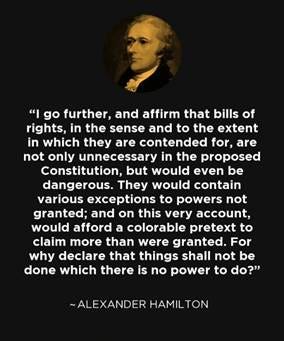
Even with big thanks to the “Anti-Federalists” who demanded that a Bill of Rights was necessary, we now have a government that continually tramples over the 9th and 10th Amendments, making the 9th and 10th Amendments appear to have been dead on arrival with the Necessary and Proper Clause combined with the Supremacy Clause.
…This government is to possess absolute and uncontrollable power, legislative, executive, and judicial, with respect to every object to which it extends... The government then, so far as it extends, is a complete one, and not a confederation. It appears from these articles, that there is no need of any intervention of the state governments, between the Congress and the people, to execute any one power vested in the general government, and that the constitution and laws of every state are nullified and declared void, so far as they are or shall be inconsistent with this constitution…Brutus I
There is no easy fix at this point, but if we all could at least understand why the federal government grew into the monster that it did, it would help us try to come up with a strategy to combat the ever-growing corruption and expansion of power.
Many people had high hopes that President Trump would drain the swamp and rein in spending, but the reality is, when he entered office, the national debt was still under $37 trillion dollars, and today it has already surpassed $38 trillion dollars and the oval office now looks like Marie Antoinette decorated it. That should not take away from the numerous positive achievements President Trump has accomplished, despite the attacks, but if we continue to increase spending, expanding our national debt, how is that sustainable?
Thanks for reading Squandering Our American Inheritance! If you would like to support my work, please feel free to share it.
Now go to Liz’s page and subscribe before you even comment here!

Great post. The more and more I've read about Alexander Hamilton I've come to see what an absolute monster he truly was, just wish he and Burr had dueled long before his influence corrupted the republic.
I'm only aware of one error he made but it was more amusing than substantial. Here it is...
"Now, in a large extended country, it is impossible to have a representation, possessing the sentiments, and of integrity, to declare the minds of the people, without having it so numerous and unwieldly, as to be subject in great measure to the inconveniency [of] a democratic government.
"The territory of the United States is of vast extent; it now contains near <b>three </b>millions of souls, and is capable of containing much more than ten times that number. Is it practicable for a country, so large and so numerous as they will soon become, to elect a representation, that will speak their sentiments, without their becoming so numerous as tobe incapable of transacting public business? It certainly is not.
Brutus I (October 18, 1787)
https://www.consource.org/document/brutus-i-1789-5-28/
He was off by an order of magnitude but that actually strengthens his point!
All of his stuff is well worth reading.